How to do your own SEO as a sign shop
1. Ask every customer for a Google review
Send your Google review link or QR code once the job is up, and ask for an honest review. More reviews went with a higher map place in every search I tested, and you don't need hundreds: most of the top-3 shops had fewer than 50. Never pay or offer a discount for a review; Google bans it.
2. Make "Sign shop" your main category
Most of the top-3 shops on the map use it. Then add only the extras that name work you do every week, such as Banner store: the best Google Business Profile category for a sign company.
3. Trade under a name that says what you do
"Sign" or your town in your real business name went with a higher place. If you're naming a new shop, put either in it. Already trading? If you want to get the most out of your SEO, a DBA (a registered trade name) with "sign" or your town in it is an option, used on your storefront, website and paperwork too. Never add the words to your Google profile alone: Google can suspend a profile for that.
4. Fill in your whole Google profile
Your address, hours, website link and photos, and a reply to every review. Google says businesses with complete and accurate info are more likely to show up in local search results. The full setup is on Google Business Profile for sign companies.
5. Give each sign type its own page
Channel letters, monument signs, vehicle wraps, banners: a page for each, with the sign type in its heading, and "sign" in your homepage heading, as about half of the top map shops have it. More on website design for sign shops.
6. End every page with a quote form
Ask the size, material, quantity and deadline, so you see the job before you call back.
7. For commercial work, win the normal results
For "channel letter signs" and "pylon signs" the map shows only a few businesses, and about half of the top Google results are sign companies' own websites. Your channel letter and pylon pages are how a GC or property manager finds you: SEO tips for commercial sign companies.
8. Don't worry about what you can't change
Distance to the searcher counts, and you can't move your shop, so the steps above matter more. For the rest of your marketing, beyond Google, see a sign shop marketing plan.
- 1Get reviews
- 2"Sign shop" as the main type
- 3Your real name
- 4A complete profile
- 5A page per sign type
- 6A quote form
- 7Commercial pages
- 8Distance you can't change
Or have me do it for you
If you'd rather run your shop than your SEO, I do all of it for $297 a month: your Google profile, your website (a new website too), AI answers and national SEO. If you don't get leads in 3 months, I work for free until they come. See the $297 price and how the guarantee works.
The study behind the guide
Everything above comes from this research. It's a single snapshot from October 2026: it shows what goes with a higher place on the map, not proof of cause, and the full numbers and limits are below.
What the top 3 on Google Maps have
Of the 177 sign businesses, 56 are in the top 3 on Google Maps for "sign shop" in their town and 105 are #4 to #10. These are raw comparisons, nothing held fixed: they describe what the top shops have, not what causes the rank.
| What they have | Top 3 | #4 to #10 |
|---|---|---|
| Median Google reviews | 24.5 | 15 |
| Main category "Sign shop" | 44 of 56 (79%) | 84 of 105 (80%) |
| Median photos | 18.5 | 15 |
| A working website | 46 of 56 (82%) | 75 of 105 (71%) |
| A quote form (working sites) | 19 of 46 (41%) | 21 of 75 (28%) |
| 5 or more sign-type pages (working sites) | 19 of 46 (41%) | 20 of 75 (27%) |
| The word "sign" in the homepage H1 (working sites) | 24 of 46 (52%) | 21 of 75 (28%) |
| Site in the normal top 20 for "sign shop" plus the town | 17 of 46 (37%) | 12 of 75 (16%) |
Median Google reviews
A quote form
5 or more sign-type pages
"Sign" in the homepage H1
In the normal top 20
The biggest gap is reviews. The main category barely differs, because almost everyone already uses "Sign shop". The website gaps are real shares, but most of them didn't hold up once each shop was compared with its own town (below).
What I checked for every sign business
- Map rank. The top 20 on Google Maps for "sign shop", "custom signs", "channel letter signs" and "pylon signs". Mobile Google, US English, pinned to each town centre.
- Google Business Profile. Main category, business name, number of reviews and photos, distance from the search point.
- Website. 133 own sites: a quote form, the sign-type pages linked from the homepage (channel letters, monument, pylon, vehicle wraps, banners, ADA and wayfinding, and more), the homepage H1 and title.
- Normal results. Google's normal results for each of the 4 searches plus the town name, top 20.
- 1Map rank
- 2The Google Business Profile
- 3The website
- 4The normal search results
The 20 towns
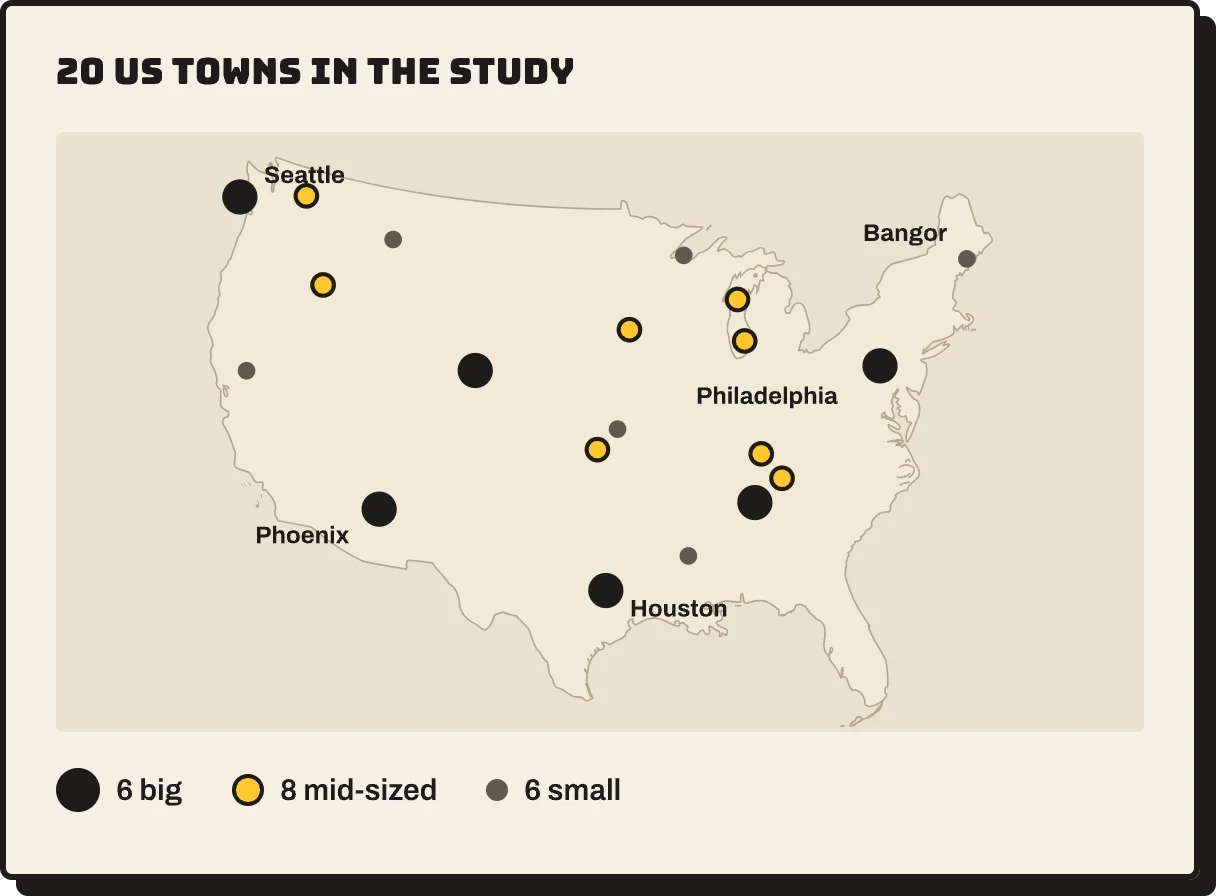
6 big, 8 mid-size and 6 small towns: the same towns as my screen printing study, so the trades can be compared.
- Big: Houston TX, Atlanta GA, Phoenix AZ, Denver CO, Philadelphia PA, Seattle WA.
- Mid-size: Boise ID, Knoxville TN, Spokane WA, Des Moines IA, Grand Rapids MI, Tulsa OK, Greenville SC, Fort Wayne IN.
- Small: Bozeman MT, Hattiesburg MS, Joplin MO, Wausau WI, Chico CA, Bangor ME.
In 13 of the 20 towns, Google filled all 20 map places for "sign shop". The rest had fewer: Hattiesburg 4, Bangor 8, Spokane 11, Joplin 14, Chico 15, Boise 16, Knoxville 18. For the national count of shops, see how many sign companies are in the US.
Does SEO work for sign companies? What moved the map
Most SEO advice for the sign industry gives every tip the same weight: keywords, content, photos, backlinks. This test checks which ones went with a higher place. Each sign business was measured against the other shops in its own town, with 11 factors held fixed together: reviews, distance, the business name, the main category, the website and photos among them. Reviews held up in all 3 searches:
| Each doubling of Google reviews | "sign shop" | "custom signs" | "channel letter signs" |
|---|---|---|---|
| Map places higher | 0.57 | 1.61 | 0.91 |
| How sure | Clear | Clear | Clear |
So a shop with twice the reviews of a similar shop in its town sat about half a place to 1.6 places higher. It's a strong result: clear in every search tested.
Does the business name help a sign shop rank?
Yes, when it's the shop's real name. "Sign" in the business name went with a higher place: clearly for "custom signs" (2.92 places) and "channel letter signs" (6.17 places), and in the same direction for "sign shop". The town in the name went with 2.12 places higher for "sign shop" and 3.30 for "custom signs", both clear.
That only counts for your real-world name. Google says "Your name should reflect your business's real-world name," and "Including unnecessary information in your business name isn't permitted, and could result in the suspension of your Business Profile." So this is about choosing a name or a legal trade name (DBA), not adding keywords to your profile listing.
Went with a higher map place
- A real business name with "sign" or the town in it
Breaks Google's rules
- Words added to the profile name alone
Does the Google Business Profile category matter?
It's the floor, not the edge. 79% of top-3 shops use "Sign shop" as their main category, and 80% of shops at #4 to #10 do. But compared with their own town, shops with another main category (Neon, Vinyl, Print shop and others) sat about 1.5 places lower for "sign shop". For "channel letter signs" the result was just short of clear, and for "custom signs" there was no effect.
Google's matching is loose: 20 of the 192 businesses in the "sign shop" top 10 weren't sign businesses at all, coffee shops, a bagel shop and a parking garage among them. It's how you tell Google what you are.
Shops with another main category sat about 1.5 places lower for "sign shop"
How much does distance matter in Google Maps?
For "sign shop", each doubling of distance from the searcher went with about 1.85 places lower, and it was clear. For "custom signs" and "channel letter signs" distance wasn't clear. Google says local results are "mainly based on relevance, distance, and popularity", and distance is something a shop can't change. Limit: every search was made from the town centre, so this shows that being near the searcher helps, not where your buyers are.
For "sign shop", each doubling of distance from the searcher went with
About 1.85places lower on the mapCommercial sign searches barely use the map
Google Maps results per town, out of a possible 20 (median):
| Search | Median map results per town |
|---|---|
| "sign shop" | 20 |
| "custom signs" | 20 |
| "channel letter signs" | 3 (1 to 9) |
| "pylon signs" | 1 (0 to 4) |
For "pylon signs", Atlanta, Boise and Knoxville returned no map results at all. So commercial buyers mostly see the normal results, and that's where visibility for commercial signage is won. There, sign companies' own websites held at least 192 of the 400 top-10 places for "channel letter signs" and "pylon signs" plus the town: 68 from the map study's businesses and 124 from sign companies outside it. Directory and social listings such as MapQuest, Yelp and Facebook held 125. Big stores (Target, Walmart, Meijer, Michaels) took 6 of the 50 top-3 places for "channel letter signs", in Grand Rapids and Wausau.
Half the retail winners also win commercial: 28 of the 56 top-3 sign businesses for "sign shop" are also top 3 for "channel letter signs". More on this in commercial sign company marketing.
Does a sign shop's website still matter?
Of the 177 sign businesses, 133 had their own site that could be checked, 23 had no website on the profile, 19 sites couldn't be opened (14 block automated visits, 5 broken) and 2 pointed at a social page only.
The word "sign" in the homepage H1 went with 3.80 places higher for "custom signs", once each shop was compared with its own town, and in the same direction for the other two searches. Raw, 52% of top-3 sites have it, against 28% at #4 to #10. Only one search was clear, so treat it as likely, not proven. A quote form and pages for each sign type are more common on top-3 sites (41% against 28%, and 41% against 27% with 5 or more sign-type pages), but they didn't hold up across searches, so I don't count them as ranking factors. They're still where a buyer asks for a quote, and a page for each kind of signage you make tells the buyer you do that work. More in website design for sign shops.
- 133 with their own website checked
- 23 with no website
- 19 sites that couldn't be opened
- 2 with a social page only
How the study was done
The sample
- 20 US towns: 6 big, 8 mid, 6 small. Mobile Google, US English, pinned to the town centre (Maps zoom 13), top 20 per search.
- 4 searches: "sign shop" and "custom signs" (retail), "channel letter signs" and "pylon signs" (commercial). Maps searched with no town name; normal results searched as the search plus the town.
- 213 businesses: the top 10 on Maps for "sign shop" or "channel letter signs" in any town (192 from "sign shop", 78 from "channel letter signs", 57 in both).
- 177 of them are sign businesses (a sign, banner or vehicle-wrap category). Of the 192 in the "sign shop" top 10, 11 were print or copy shops without a sign category and 20 weren't sign businesses at all. Every test uses the 177 sign businesses only.
- Websites: 133 own sites checked, 23 with no website on the profile, 19 that couldn't be opened, 2 with a social page only. 10 sites build their pages with JavaScript and were opened in a browser.
- Data pulled 2026-10-30. Business names stay out of everything published.
How each factor was tested
A same-town comparison: each sign business measured against its own town's average, with 11 factors in one model, and 2,000 re-draws of whole towns for the range (90%). "Clear" means the 90% range doesn't cross zero. A shop not in a search's top 20 counts as place 21. It's one snapshot, so it shows what goes with a better place once the other factors are equal, not a before-and-after test.
How sure is each finding
33 tests were run (11 factors × 3 searches), so about 3 "clear" results could be luck. A finding is only called solid when it's clear in all or most searches, points the same way everywhere and fits how local ranking works: reviews and the business name. The main category, "sign" in the homepage H1 and distance are likely, each with the limit given above.
Unconfirmed leads (not advice)
- A quote form: clear for "custom signs", the other way for "channel letter signs".
- Sign-type pages: clear for "channel letter signs" only, about half a place per page.
- The town in the homepage title looked worse for "sign shop", likely chance or homepages that repeat the town too often.
- A working website and photos: no clear effect.
What we did not measure
- Google posts.
- What the reviews say.
- Links to the website.
- AI answers.
- Who gets the calls or the jobs: the study shows who ranks.
Rather have me do it?
I set up your Google profile, website and AI answers for $297 a month. Leads in 3 months, or I work for free.
Have me do it: get your free growth plan